
About the Artists
-

Boito
Collective since 2022
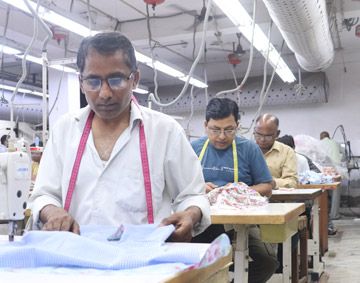
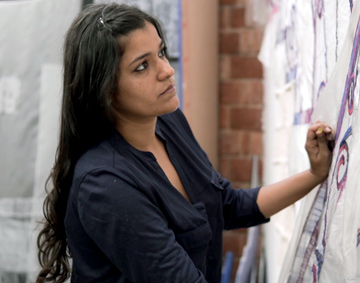
Odisha, IndiaBoito is an art and fashion brand based in Odisha, India, working closely with regional artisan communities. Their practice brings together weaving, painting, embroidery and metalwork to reinterpret local craft traditions through myth, collaboration and contemporary exhibition-making. Their work Asareeri, part of the Navagunjara series, draws on Odishan mythology exploring connections between Korean Buddhist imagery and Indian textile traditions.
-
Yeonsoon Chang
b. Seoul, South Korea, 1950
Lives in Seoul, South KoreaYeonsoon Chang is a leading figure in contemporary Korean textile practice, known for sculptural works that explore breath, air and repetition as material forces. Her work Worincheongang references Korean Buddhist writings about the moon and its thousand reflections, drawing parallels between acts of meditation and the meticulous processes of refining, dyeing, weaving and sewing that shape textile labour.
-
Young In Hong
b. Seoul, South Korea, 1972
Lives in Bristol, UKYoung In Hong works across textile, installation and sound, centring sewing and embroidery as historically undervalued forms of women’s labour. Her work often emerges through collaboration with artisan communities, including the Kala Raksha collective in Kutch, India. Through works such as Sacred Empires, she imagines alternative worlds where animals, humans and environments coexist as equals while honouring the creativity and economic independence of women artisans.
-
Kaimurai
b. Belthangady, India, 1984
Lives in Bengaluru, IndiaKaimurai (Abishek Ganesh Jayashree) works with indigo, ritual and sound, treating textile-making as a form of prayer and meditation. Drawing on South Indian musical traditions and spiritual symbolism, his practice foregrounds the hand as a site of memory and devotion. The answer to all my prayers is in the questions I never asked brings together indigo textile paintings with a traditionally cast bronze temple bell and carved stone sphere, inspired by ritual practices and the symbolic role of bells in Korea and South Asia.
-
Somi Ko
b. Seoul, South Korea, 1977
Lives in Seoul, South KoreaSomi Ko works with hanji, traditional Korean paper, hand-spinning it into thread through a daily ritual of making. Her works People of One, Continuum and People of One, Moment combine hand-spun hanji with Gujarati textile techniques and self-supporting fibre structures, exploring the traces of human existence through a slow, experimental process.
-
PÉRO
Founded 2009
New Delhi, IndiaFounded by Aneeth Arora, PÉRO is an Indian fashion label known for its deep commitment to craft collaboration. Working with more than a thousand artisans across India over the past 15 years, the brand continues its research into traditional textile techniques through collaborative design and production, creating garments that hold time, touch and place while bridging traditional craftsmanship and contemporary fashion.
-
Sumakshi Singh
b. New Delhi, India, 1980
Lives in New Delhi, IndiaSumakshi Singh is an internationally recognised artist whose delicate thread installations reimagine architectural forms as fragile, dissolving structures. She will represent India at the 2026 Venice Biennale. For Hyundai Translocal Series: Entangled and Woven, Singh presents a new work informed by the symbolic form of a bridge - described as an “unravelling tapestry” - exploring connection, memory and the spaces between solidity and air.
-
Jounghye Yoo
b. Seoul, South Korea, 1960
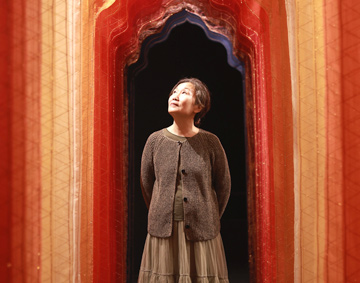
Lives in Seoul, KoreaJounghye Yoo creates large-scale textile installations that combine Korean and South Asian craft traditions. Rooted in close collaboration with master artisans, her work explores how light, movement and layered materials can create sensorial environments shaped by memory and belief. In Gilded Veil, a series of archways inspired by the Vishwanath Temple in Varanasi are rendered through Korean silk embroidery and Indian Ajrakh block printing, forming a translucent landscape of refracted light and shadow.